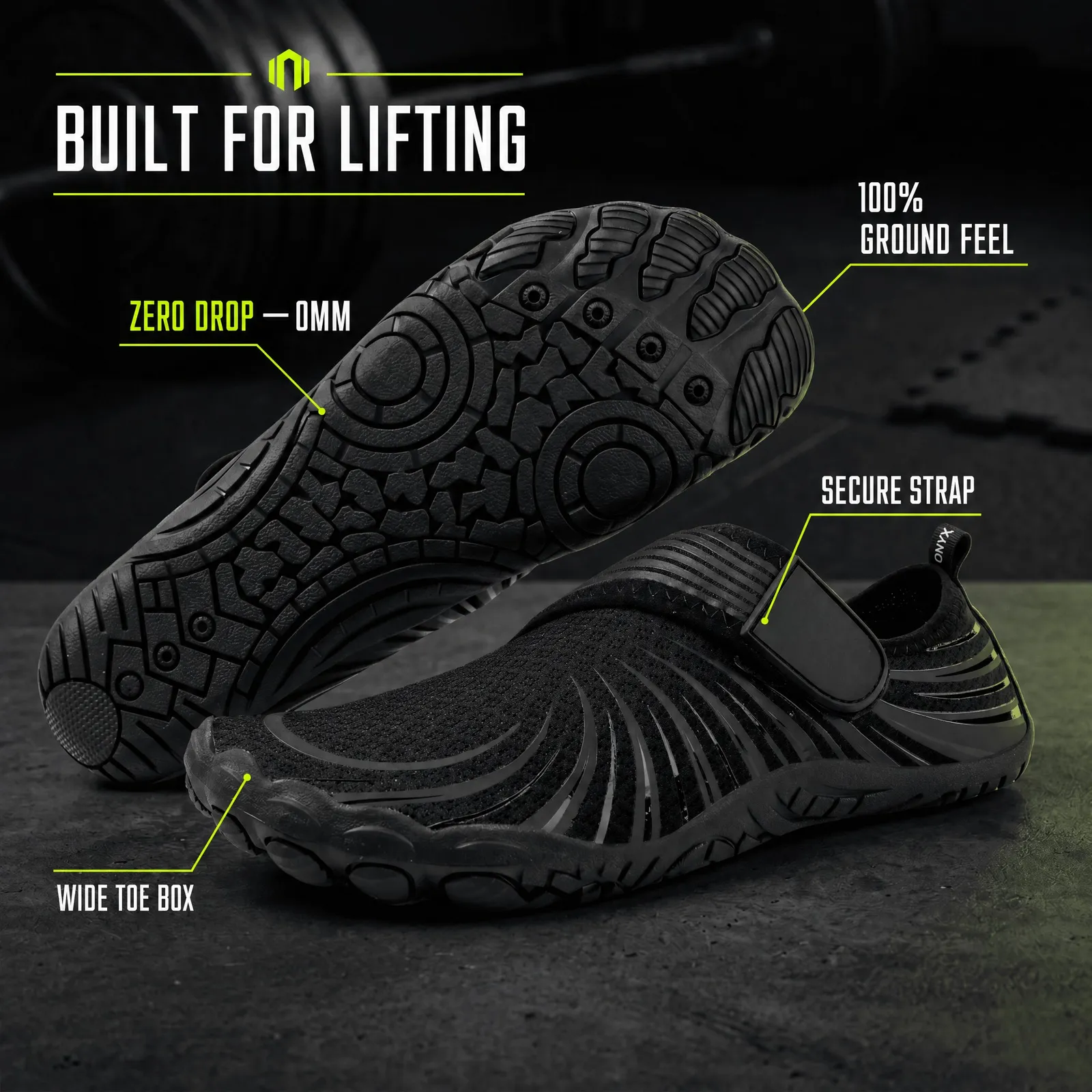
Short answer: you can run in barefoot lifting shoes for short conditioning bursts — shuttle runs, sprints, sled pushes, and the short runs inside a WOD — as long as your feet are used to flat, minimal footwear. What you should not do is use them as your dedicated shoe for long-distance road running. Lifting shoes are engineered for a stable, incompressible base, not for absorbing thousands of repeated foot strikes on pavement. Within their lane, they handle running fine; outside it, you are asking a lifting tool to do a running job.
Can you run in barefoot lifting shoes?
Yes, for the right kind of running. A flat, zero-drop lifting shoe gives you ground feel, a wide toe box, and a firm platform — all of which are genuinely good for short, athletic running like sprints and change-of-direction work. Barefoot-style running is its own established discipline, and a minimal shoe is well suited to it once your feet and calves have adapted.
The catch is impact volume. A lifting sole is firm on purpose so it does not compress under a barbell. That firmness is great for stability but means little cushioning for repeated pavement strikes. For a few hundred meters of conditioning, that is a non-issue. For a 5K on concrete, your calves, Achilles, and feet will feel every step — especially if you are not already conditioned to minimal footwear.
What kind of running works in a lifting shoe?
Think short, varied, and gym-based. These uses play to a flat shoe's strengths:
- Short WOD runs and shuttle runs. The 200–400 m runs inside CrossFit-style workouts are well within range — see our take on barefoot shoes for CrossFit WODs.
- Sprints and accelerations. Ground feel and a firm base help you drive hard off the floor.
- Sled pushes and drags. A flat, grippy sole is ideal for pushing and pulling weight.
- Agility and change-of-direction drills. A wide toe box and stable base help you plant and cut.
- Jump rope, box jumps, and plyometrics. Short ground-contact work suits a responsive flat shoe.
In all of these, contacts are relatively few and the value of a stable, connected-to-the-floor base is high — exactly what a lifting shoe delivers.
When should you NOT run in lifting shoes?
Skip the lifting shoe for sustained, high-volume running: long road runs, distance training, and daily mileage on hard surfaces. The firm sole that makes a great squat platform gives you little protection from repeated impact, and if your feet are not adapted to minimal shoes, piling on running volume is a fast track to calf strains, Achilles irritation, or foot soreness.
If distance running is a real part of your training, use a shoe built for it. A dedicated pair — whether cushioned or a purpose-built barefoot running shoe — is the right tool. Your lifting shoe is for lifting and short conditioning, not for logging miles.
Lifting shoe vs running shoe vs barefoot running shoe
Each shoe is optimized for a different job. Here is how they compare when running enters the picture.
| Footwear | Sole | Best running use | Tradeoff |
|---|---|---|---|
| Flat zero-drop lifting shoe (e.g. KRAFTBARE FORGE) | Thin, firm, incompressible, wide toe box | Short conditioning, sprints, sleds, WOD runs | Little cushioning for long-distance pavement |
| Cushioned running shoe | Thick, soft, elevated heel | Long-distance and daily road running | Unstable and squishy for heavy lifting |
| Barefoot running shoe | Thin, flexible, zero-drop, more give | Minimalist distance running (once adapted) | Requires adaptation; less firm for max lifts |
Notice that a flat lifting shoe and a barefoot running shoe are cousins — both zero-drop and minimal — but the lifting shoe prioritizes a firm, non-compressing sole for stability under load, while a barefoot running shoe adds a little flex and give for repeated strides. That is why the FORGE covers short conditioning brilliantly but is not pitched as your marathon shoe.
How to add running to lifting sessions safely
If you want to fold short running into your training in flat shoes, build up rather than diving in.
- 1. Adapt first. If you are new to minimal shoes, spend a few weeks lifting and walking in them before you add running — our transition guide shows how.
- 2. Start with short bouts. Add sprints, shuttle runs, or short WOD-style runs before any longer efforts, and keep total running volume low at first.
- 3. Land softly. Minimal shoes reward a mid-foot, quiet foot strike over a hard heel slam. Let your calves absorb the load.
- 4. Watch your calves and Achilles. Some soreness is normal early on; sharp or lingering pain means back off and build slower.
- 5. Use the right tool for distance. Keep a separate cushioned or barefoot running shoe for real mileage; save the lifting shoe for lifting and conditioning.
What makes the KRAFTBARE FORGE good for gym conditioning?
The KRAFTBARE FORGE is a true zero-drop barefoot lifting shoe with a flat, firm sole, a wide toe box, and a grippy outsole — a combination that shines for the short, mixed conditioning most lifters actually do. Sprint, push a sled, jump rope, run a quick 400, then walk back to the bar and squat — all in one shoe, with a stable base the whole time.
It is honest about its lane: it is built to be your one shoe for lifting and gym conditioning, not a distance-running shoe. If cushioning benefits are what you are weighing, our overview of the benefits of barefoot zero-drop shoes covers where flat wins and where it does not. At 69.90€ — about half the price of premium zero-drop rivals — the FORGE comes in US sizes 7–11 and five colorways: Onyx Black, Chalk, Volt, Steel, and Raw Pink.
Frequently Asked Questions
Can you run in barefoot lifting shoes?
Yes, for short conditioning like sprints, shuttle runs, sled work, and the short runs inside a WOD, provided your feet are adapted to minimal footwear. They are not designed for long-distance road running because the firm sole offers little impact cushioning.
Are lifting shoes okay for CrossFit runs?
For the short 200 to 400 meter runs common in CrossFit-style workouts, a flat zero-drop shoe works well and keeps you in one shoe for the lifting portions too. For a workout with a long run component, a more cushioned shoe may be more comfortable.
Is it bad to run long distances in zero-drop lifting shoes?
It can be if your feet are not adapted, because the firm, minimal sole gives little protection from repeated impact and can overload your calves, Achilles, and feet. For real mileage, use a cushioned or purpose-built barefoot running shoe instead.
What is the difference between a lifting shoe and a barefoot running shoe?
Both are zero-drop and minimal, but a lifting shoe uses a firm, incompressible sole for stability under load, while a barefoot running shoe adds a little flex and give to handle repeated strides. The lifting shoe is better for lifting and short conditioning; the running shoe is better for distance.
Do I need to break in lifting shoes before running in them?
If you are new to flat, minimal footwear, spend a few weeks lifting and walking in them first so your feet and calves adapt, then add short running gradually. Jumping straight into running volume in minimal shoes is the main cause of early soreness and injury.
Can barefoot shoes improve my running form?
Minimal, zero-drop shoes encourage a softer mid-foot strike and more ground feedback, which some runners find improves their form once adapted. That said, form change takes time and should be built gradually to avoid overloading the lower leg.
Want one shoe for lifting and short conditioning? The KRAFTBARE FORGE zero-drop lifting shoe gives you a flat, grippy, stable base for squats, sprints, sleds, and WOD runs alike — for 69.90€, about half the price of premium rivals.
Last updated: July 7, 2026