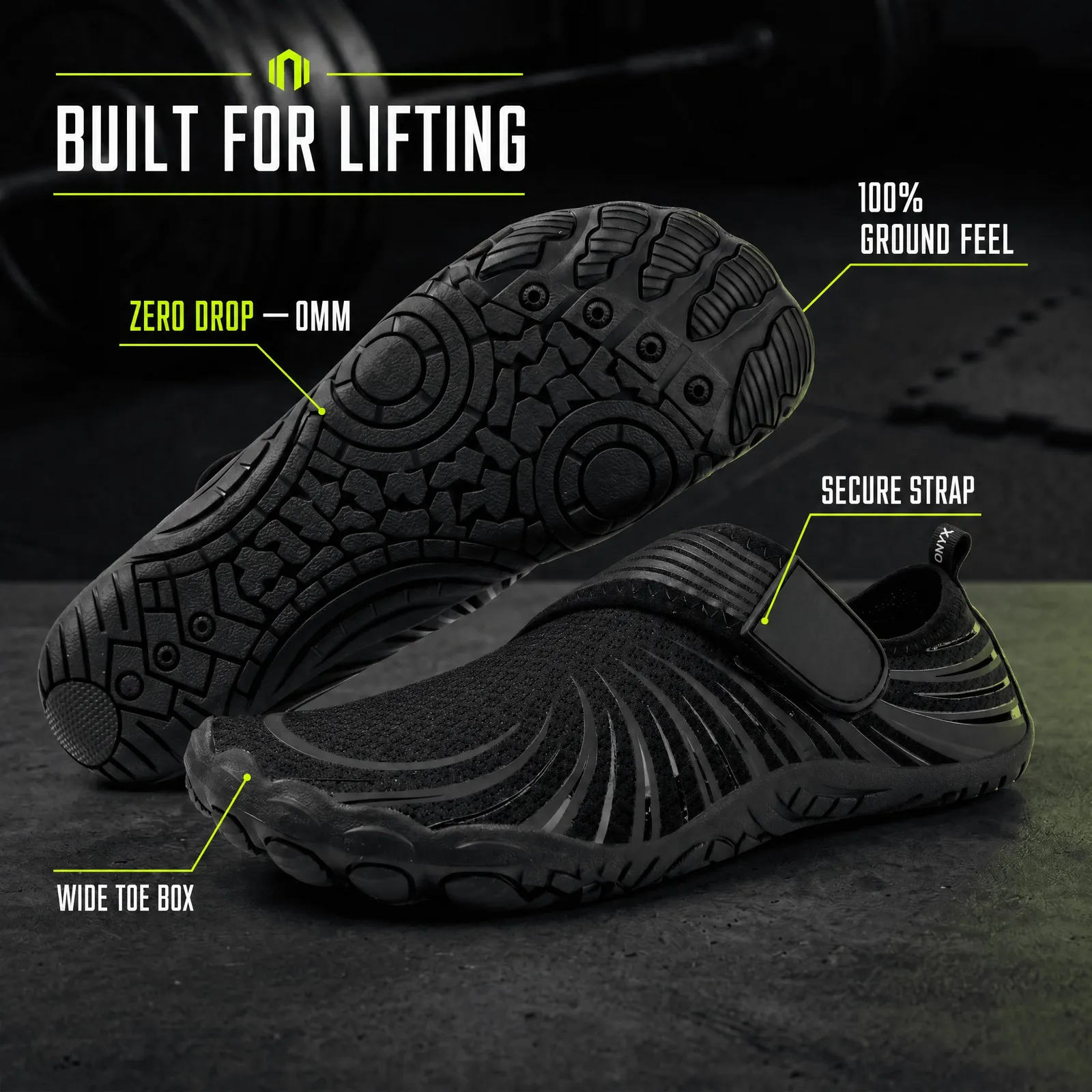
For most barbell training, the barefoot vs weightlifting shoes question comes down to this: a flat, zero-drop, incompressible shoe (barefoot-style) is the best all-around pick for deadlifts, low-bar squats, and general strength work, while a raised-heel Olympic shoe genuinely wins for high-bar and Olympic squats where ankle mobility is the limiter. Cushioned running shoes are the worst choice for lifting because the foam compresses and leaks force under load. Pick your shoe based on the lift and your mobility, not the brand on the box.
Below is a straight comparison of the four footwear types serious lifters actually argue about, a clear definition of heel drop so you can decode any spec sheet, and honest guidance on when each one earns a spot under the bar.
What is heel drop, and what does "zero-drop" mean?
Heel drop is the height difference, in millimeters, between the heel and the forefoot of a shoe. A 20mm heel and 8mm forefoot is a 12mm drop. Zero-drop means heel and forefoot sit at the same height (0mm), so your foot stays flat and level — the way it does standing barefoot on the floor.
This single number quietly dictates how you balance over the bar. A raised heel shifts your weight forward and lets your knees travel further past your toes; a zero-drop sole keeps your weight stacked over your midfoot and rewards you with direct ground feel. Running shoes muddy the picture further, because they pair a moderate drop with a tall slab of compressible foam that moves underneath you. Understanding drop is the foundation for everything else on this page — and if you want the deeper biomechanics, see our breakdown of the benefits of zero-drop lifting shoes.
Barefoot vs weightlifting shoes: which is better for lifting?
Neither is universally "better" — they solve different problems. Barefoot/zero-drop shoes win for deadlifts, low-bar squats, and most strength training by keeping you flat, stable, and connected to the floor. Raised-heel weightlifting shoes win for high-bar and Olympic squats by letting you hit depth upright when ankle mobility is the limiting factor.
The cleanest way to decide is to ask what's stopping the rep. If you fold forward or your heels lift in a deep squat because your ankles won't dorsiflex, a heeled shoe is a legitimate, mechanically sound fix — it artificially opens your ankle angle so you can stay tall and drive through a full-depth squat. That's why competitive Olympic lifters almost universally wear heeled shoes; it's not hype, it's leverage.
But that same raised heel is a liability on a deadlift. It adds range of motion you have to pull through and pushes your weight toward the front of your foot, exactly the opposite of what you want when you're trying to drive the floor away and keep the bar over your midfoot. For pulling, flat wins. For a full rundown by lift, our guides on the best shoes for squats and the best shoes for deadlifts go deeper than we can here.
The 4-way footwear comparison table for lifting
This table compares the four footwear types lifters actually choose between — barefoot/zero-drop, raised-heel Olympic, cushioned running, and flat canvas (Converse-style) — across the specs that change how the bar moves. Use it to match the shoe to the lift, not to brand marketing.
| Footwear type | Heel drop | Sole compressibility | Toe box | Best lifts | Worst lifts | Typical price (EUR) |
|---|---|---|---|---|---|---|
| Barefoot / zero-drop (e.g. KRAFTBARE FORGE) | 0mm (true flat) | Firm, incompressible | Wide, anatomical | Deadlifts, low-bar squats, strength & functional work | None critical; less ideal for max-mobility Olympic squats | 70€-200 (69.90€ for FORGE) |
| Raised-heel weightlifting (Olympic) | ~15-22mm (effective) | Hard, incompressible | Narrow to medium | High-bar & Olympic squats, front squats, overhead | Deadlifts, running, lateral movement | 120€-220 |
| Cushioned running | ~8-12mm | Soft, highly compressible | Tapered | Running (not lifting) | Squats, deadlifts, any heavy barbell lift | 110€-180 |
| Flat canvas (Converse-style) | 0mm flat but thin | Firm but thin/uneven | Narrow, tapered | Deadlifts, casual lifting on a budget | Heavy squats (thin sole, no lateral support), long-term toe splay | 55€-75 |
For the canvas option specifically, we wrote a whole honest assessment of whether Converse are good for lifting — short version: fine for pulling, compromised for serious squatting because of the narrow, tapered last and thin uneven sole.
Can you lift in running shoes? Why are they the worst pick?
You can, but you shouldn't for anything heavy. Running shoes have a soft, compressible foam midsole built to absorb impact for your forefoot strike. Under a loaded barbell that foam squishes and shifts unpredictably, leaking force you're trying to send into the floor and creating an unstable, tippy base — exactly what you don't want when stability is everything.
Think of it as a force leak. When you brace and grind out a heavy squat, you want every newton you produce traveling down through a rigid platform into the ground. Soft foam stores and releases some of that energy at the wrong moment, like trying to jump off a mattress instead of concrete. It also wobbles side to side, so your knees and ankles spend energy fighting the shoe instead of moving the load. Cushioning is a feature for running and a bug for lifting.
When do raised-heel Olympic weightlifting shoes actually win?
Raised-heel shoes genuinely win whenever ankle mobility limits your squat depth or upright posture: high-bar back squats, front squats, and the snatch and clean & jerk. The elevated heel opens your ankle angle so you can reach full depth while keeping your torso tall and the bar over your midfoot — a real mechanical advantage, not marketing.
This is the honesty part that too many barefoot brands skip. If you're chasing a big high-bar squat, training the Olympic lifts, or you simply have stiff ankles that no amount of mobility work has fully fixed, a heeled shoe will let you train positions you otherwise can't reach. The zero drop vs heeled weightlifting shoes debate isn't a war with one winner; it's a tool selection problem.
Where heeled shoes lose is everywhere else: they're useless for deadlifts, clumsy for any conditioning or lateral work, expensive, and they let you avoid building the ankle mobility that flat training develops over time. If your goals are general strength, powerlifting-style training, and functional fitness, you'll spend most of your sessions wishing you had a flat shoe on.
Why are deadlifts barefoot's strongest case?
Deadlifts are where flat, zero-drop shoes are objectively the best choice. A zero-drop sole minimizes the distance the bar travels, keeps your weight over your midfoot and heels for maximum leverage, and gives you a stable, grounded base to drive the floor away. Any heel lift adds range of motion and tips you forward — both bad for pulling.
Lifters who can't go truly barefoot in their gym reach for flat shoes for exactly this reason. The shorter the bar travels and the more solidly your heel is planted, the more weight you can pull and the safer your setup. A firm, incompressible zero-drop sole gives you the barefoot advantage plus toe protection, grip, and a bit of lateral structure — which is precisely the niche the KRAFTBARE FORGE is built for.
Where does the KRAFTBARE FORGE fit?
The FORGE is a true zero-drop, incompressible-soled barefoot lifting shoe built specifically for the barbell — squats, deadlifts, strength and functional training. It pairs a flat, firm platform with a wide, anatomical toe box for natural foot splay and real ground feel, at 69.90€: roughly half the price of premium barefoot and lifting rivals that run 130€-200.
It's the right call if most of your training is deadlifts, low-bar squats, pressing, and mixed-modal strength work, and you want one honest, do-everything shoe instead of a closet of single-purpose footwear. In our own testing the firm sole and wide toe box noticeably improve how planted you feel during heavy pulls compared to a tapered canvas sneaker — a qualitative observation, not a lab claim.
It is not the right call if your priority is max-effort high-bar or Olympic squatting with limited ankle mobility — that's the one scenario where a dedicated heeled shoe still wins, and we'd rather tell you that than sell you the wrong tool. A few notes on specifics:
- True zero-drop: heel and forefoot level at 0mm, unlike NOBULL's 4mm drop, which isn't true zero-drop.
- Five colorways: Onyx Black, Chalk, Volt, Steel, and Raw Pink.
- US sizes 7-11, with sizing guidance in our FORGE sizing guide.
- Wide toe box for natural splay and a stable base on every lift.
New to flat training? Don't switch cold-turkey at heavy loads — follow our guide on how to transition to zero-drop lifting so your calves and feet adapt without complaint.
Frequently Asked Questions
Are barefoot shoes or weightlifting shoes better for squats?
It depends on the squat and your ankles. Raised-heel weightlifting shoes are better for high-bar and Olympic squats where ankle mobility limits depth. Barefoot zero-drop shoes are better for low-bar squats and lifters with good mobility who want a flat, stable, grounded base over their midfoot.
Can you deadlift in running shoes?
You can, but it's a poor choice. Running shoes have soft, compressible foam that squishes under load, raising you off the floor, lengthening the pull, and creating an unstable base. A flat, firm zero-drop or barefoot shoe keeps the bar lower and your heels planted, letting you pull more weight more safely.
What does zero-drop mean in lifting shoes?
Zero-drop means the heel and forefoot of the shoe sit at exactly the same height — a 0mm heel-to-toe difference. Your foot stays flat and level like it does barefoot on the floor, keeping your weight stacked over your midfoot for stable squatting and pulling without the forward tilt a raised heel creates.
Are flat shoes good for lifting weights?
Yes, for most lifting. Flat, firm-soled shoes keep you stable and grounded, which is ideal for deadlifts, low-bar squats, and general strength work. The exception is high-bar or Olympic squatting with stiff ankles, where a raised heel helps you reach depth upright. Avoid thin, tapered canvas shoes for very heavy squats.
Is the KRAFTBARE FORGE true zero-drop?
Yes. The FORGE has a true zero-drop sole, meaning 0mm difference between heel and forefoot. This contrasts with shoes like NOBULL trainers, which use a 4mm drop and aren't genuinely zero-drop. The FORGE pairs that flat platform with an incompressible sole and wide toe box for barbell training.
Do I need special shoes to start lifting?
Not immediately — bare feet or any flat, firm-soled shoe works fine for beginners on most lifts. As you add load, a dedicated flat or zero-drop shoe improves stability and confidence, especially under heavy squats and deadlifts. Avoid cushioned running shoes from day one, since the soft foam undermines your base.
Last updated: June 30, 2026