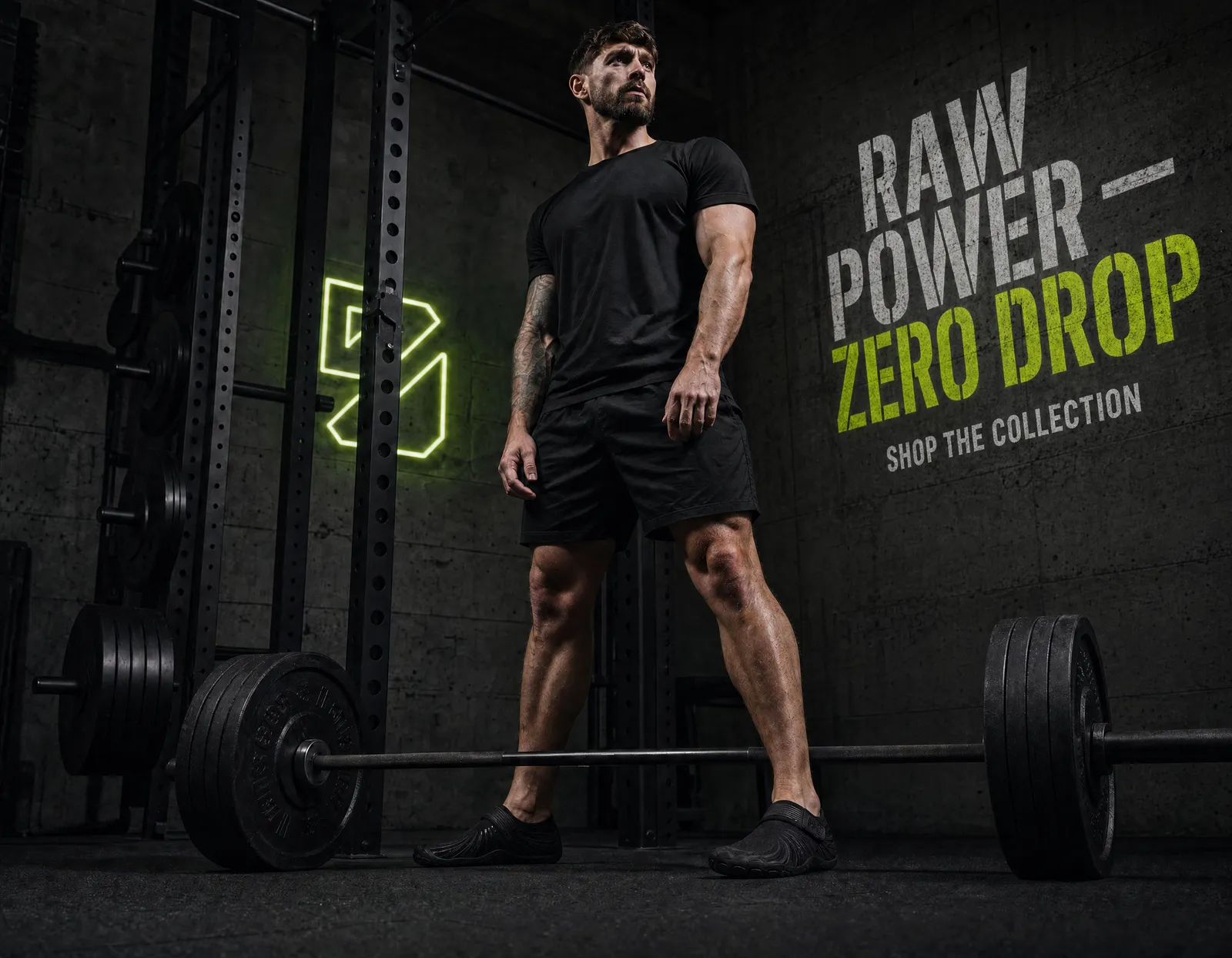
To learn how to size barefoot lifting shoes like the KRAFTBARE FORGE, trace your bare foot against a wall, measure heel-to-longest-toe length, and add roughly a thumb's width (about 0.4–0.6 in / 10–15 mm) of toe room — then match that to your US size. The FORGE runs in US 7–11 and is built around a wide toe box, so both length and width matter. Most lifters take their normal athletic shoe size; if you're between sizes or have wide feet, bunions, or like thicker socks, size up.
How do you size barefoot lifting shoes like the FORGE?
Measure your bare foot length (heel to longest toe) and your foot width at the widest point, both standing with weight loaded. Add about a thumb's width of length so toes can splay under a heavy bar. Match the longer foot to a US 7–11 size. Barefoot shoes prioritize toe splay, so width is as important as length.
A heeled Olympic lifting shoe locks your foot into a snug, structured last because you want zero movement under a snatch or clean. A barefoot shoe like the FORGE does the opposite: it gives your foot room to spread, grip the floor, and drive through a stable base. That changes how you should size it. You are not chasing a glove-tight race fit — you're fitting for ground contact and toe splay under load. If you've only ever bought running shoes or cross-trainers, this is the mental shift to make first. For the deeper biomechanics, see our breakdown of zero-drop and barefoot lifting benefits.
How do you measure your foot to size the KRAFTBARE FORGE? (step-by-step)
Trace each bare foot on paper while standing, mark heel and longest toe, measure that length in millimeters, then measure the widest part of your forefoot. Do it in the evening when feet are largest, measure both feet, and size to the bigger one. Add a thumb's width of toe room before choosing your US size.
Here is the exact protocol we recommend. Do it standing — your foot lengthens and widens when it bears weight, and that loaded shape is the one that matters under a barbell.
- Tape a sheet of paper to a hard floor against a wall. Carpet distorts the trace.
- Stand with your heel touching the wall and full body weight on the foot you're measuring.
- Trace around the foot holding the pen vertical, or mark two points: the back of the heel and the tip of your longest toe (often the second toe).
- Measure heel-to-longest-toe length in millimeters. This is your foot length.
- Measure forefoot width across the widest point (usually the ball of the foot / base of the big toe).
- Repeat for the other foot — feet are rarely identical. Size to the longer and wider one.
- Add a thumb's width (≈10–15 mm) to your length for toe-splay and downhill toe room under heavy loads.
- Measure in the evening or after training, when feet are at their largest.
- Match the larger foot to your US 7–11 size, sizing up if your width measurement or socks push you to the edge.
This is the same length-plus-thumb logic shoe fitters have used for decades, just applied to a flat, wide last instead of a tapered running shoe. For a model-by-model comparison of how different brands fit, our guide to the best barefoot lifting shoes is a useful companion.
Do barefoot shoes run true to size?
Generally, yes — most lifters take their normal US athletic shoe size in the FORGE. Barefoot shoes feel different because the wider toe box gives more forefoot room, not because the length runs short or long. The honest answer: don't assume, measure. If your traced length plus a thumb's width lands between two sizes, choose the larger one.
The phrase "do barefoot shoes run true to size" gets asked constantly, and the reason is that barefoot shoes feel roomier even at the correct length. That extra space is the wide toe box doing its job, not a sizing error. Where people actually get burned is by guessing instead of measuring, or by carrying over a snug running-shoe habit into a shoe designed to let the foot spread. Measure first. We'd rather you read this paragraph twice than return a pair.
Are barefoot lifting shoes good for wide feet, bunions, or flat feet?
Yes — a wide toe box is the main reason many wide-footed lifters and people with bunions switch to barefoot shoes. The FORGE's wide forefoot lets the toes splay instead of being squeezed into a taper. For genuinely wide feet, prioritize your width measurement: if length says one size but width is tight, size up.
Tapered athletic shoes wedge the big toe inward, which can aggravate bunions and rob you of a stable base. A wide toe box lifting shoe reverses that — your forefoot spreads, your arch engages, and your platform under the bar gets wider and more honest. If you have bunions or a high-volume forefoot, treat width as the deciding measurement, not length. When your traced width sits near the edge of a size, going up one size buys forefoot room without making the shoe sloppy, because a flat barefoot last doesn't rely on heel lockdown the way an Olympic shoe does.
KRAFTBARE FORGE sizing: US 7-11 quick reference
The FORGE comes in US 7–11. Use this as a framing tool, not a substitute for measuring: take your true bare-foot length, add a thumb's width, and pick the US size that comfortably contains it. When length and width disagree, the larger size wins. The table below shows how to read your measurement against each decision point.
| Your situation | What to do | Why |
|---|---|---|
| Measured length matches one clear US size (7–11) | Order that size | You're true to size; the wide toe box adds room without changing length |
| Between two sizes | Order the larger size | Toe-splay room beats a cramped fit under heavy load |
| Wide feet or bunions | Size up if width is tight | Forefoot width is the limiting dimension, not length |
| You train in thick or padded socks | Size up | Sock volume eats forefoot and length room |
| Thin socks or barefoot-style socks | Stay true to size | Minimal added volume; your traced measurement stands |
| Narrow feet, thin socks, true-to-size length | Order your standard US size | No reason to deviate from your measured length |
For a full walkthrough of the trace-and-measure step before you commit, jump back to the measurement protocol above, and if you're brand new to a flat sole, read how to transition to zero-drop lifting so the first few sessions feel right.
Should you size up the FORGE for socks or between sizes?
Yes on both counts. If you train in thicker or padded socks, size up — sock volume eats real space. If your measurement lands between two FORGE sizes, also size up. A slightly roomier barefoot shoe still performs well because it doesn't depend on heel lockdown, whereas a cramped one kills toe splay and ground feel.
Sock thickness is the variable most people forget. A thin athletic sock barely changes your fit; a cushioned crew sock can effectively cost you a half-size of forefoot room. Decide what you'll actually lift in, measure with that in mind, and size up when in doubt. The downside of a touch too much room in a flat, wide shoe is minor. The downside of too little is crunched toes and a worse base under the bar.
When should you choose a heeled shoe instead of the FORGE?
Choose a heeled Olympic lifting shoe for high-bar Olympic squats, snatches, cleans, and max-effort overhead work where a raised heel improves ankle range and upright torso position. The FORGE and other zero-drop shoes win for deadlifts, conventional and sumo pulls, low-bar squats, and general strength training where a flat, stable base matters most.
We'd rather be honest than sell you the wrong tool. If your training is built around the Olympic lifts or deep high-bar squats and you lack ankle mobility, a heeled shoe genuinely helps and we won't pretend otherwise — the barefoot vs weightlifting vs running shoes comparison lays out exactly where each one wins. But for the lifter who deadlifts heavy, squats below parallel without needing a wedge, and does mixed strength work, a true zero-drop shoe like the FORGE keeps you closer to the floor and more stable. See our deep dive on the best shoes for deadlifts for the pull-specific case, and browse the rest of the Arsenal Collection if you want the full lineup.
Frequently Asked Questions
Does the KRAFTBARE FORGE run true to size?
Most lifters take their normal US athletic shoe size in the FORGE. It feels roomier than a tapered shoe because of the wide toe box, not because the length runs off. Trace your foot, add a thumb's width, and if you land between sizes, order the larger one.
How do I measure my foot for barefoot lifting shoes?
Stand with your heel against a wall and trace each bare foot on paper. Measure heel to longest toe in millimeters, then measure forefoot width. Do it in the evening, size to the larger foot, and add about a thumb's width of length for toe splay under load.
Are the FORGE shoes good for wide feet or bunions?
Yes. The wide toe box is a primary reason wide-footed lifters and people with bunions choose barefoot shoes — the forefoot can splay instead of being squeezed. If your width measurement is tight at your length size, size up. Width, not length, is the deciding dimension for wide feet.
Should I size up the FORGE if I wear thick socks?
Yes. Thick or padded socks add real volume and can cost you up to a half-size of forefoot room. Decide what socks you'll train in, measure with those in mind, and size up if you're a between-sizes case or you favor cushioned socks.
What sizes does the KRAFTBARE FORGE come in?
The FORGE is available in US sizes 7 through 11, in five colorways: Onyx Black, Chalk, Volt, Steel, and Raw Pink. It's a true zero-drop, wide-toe-box barbell shoe priced at 69.90€, roughly half the cost of premium barefoot rivals in the 130€–200 range.
What if I'm between two FORGE sizes?
Order the larger size. A barefoot shoe doesn't depend on tight heel lockdown, so a touch of extra room still performs well and preserves toe splay and ground feel. A cramped fit, by contrast, narrows your base under the bar and undercuts the whole point of a wide toe box.
Ready to commit? Measure your feet using the protocol above, then grab the KRAFTBARE FORGE zero-drop lifting shoe at 69.90€ — true zero-drop, wide toe box, US 7–11, five colorways, and about half the price of the premium barefoot crowd. Still deciding if a flat shoe fits your training? Start with do you need special shoes to lift, then come back and order with a measurement instead of a guess.
Last updated: June 30, 2026